Currently this website is not fully ready for mobile devices. Please view it on a desktop or laptop computer for a better experience.
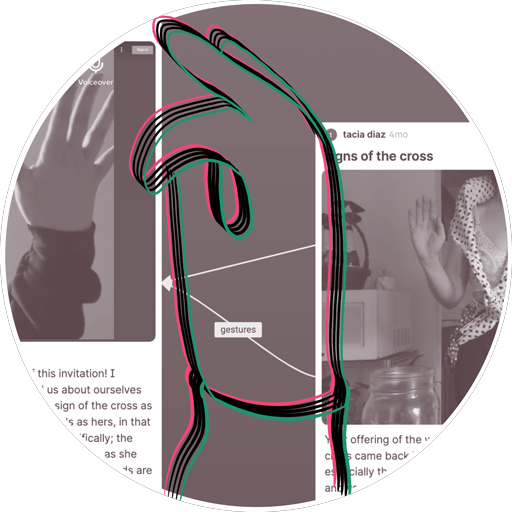

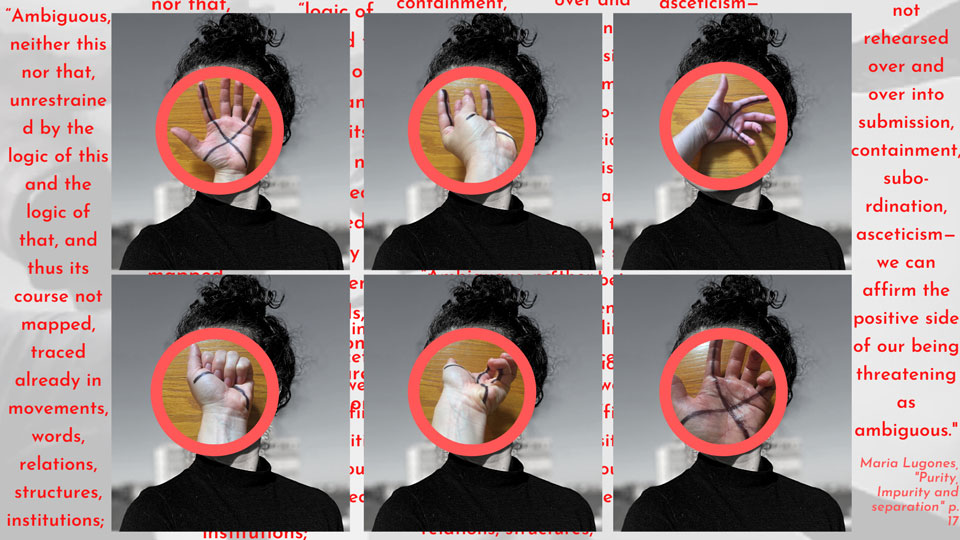
I make the sign of the cross as was taught to me by my grandmother.
I think of my hands as hers
I think of my hands as hers
the role of religion I've invoked here is also a result of her influence, as she tried very hard to raise her family as devout Mexican Catholics
Hands are links, I think, and ways of connecting, and for me a reminder
(Lili, String Figurer)
Your offering of the way your grandmother showed you how to make this sign of the cross came back into my mind as I've been playing with the tension textile friend. …
I feel like everyone is always looking at each other to remember the right moments to do so and I think it's a sweet bumbling that we do. In the end, I think about how the looking to the others there with you, the care into wanting to do things well is enough (: …
(Tacia, String Figurer)

I twirl… “I have rarely heard about my mother’s or abuela’s lives as children. I have been told repeatedly that I was serious as a child.. In twirling I am questioning whether any of us twirled as daughters and little girls…
I twirl as an adult woman in privacy and wonder whether this seriousness has boiled down and away in each of us and whether they dance or move, in silence, when alone. ”
(Victoria, String Figurer)
“What does it mean to spin in circles? I think this tends to be thought of in a bad way, but here there's so much freedom in spinning - it's a moment of freedom and of revisiting a past in a way that is inherently negative or even passive. I think it can do any of us good!” (Lili, String Figurer)
There is so much freedom in going in circles(Lili, String Figurer)
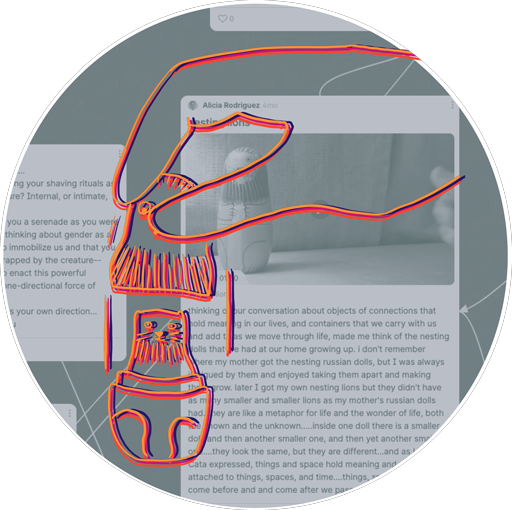
Nesting lions.. there are ..“containers that we carry with us and add to as we move through life...later I got my own nesting lions
.....inside one doll there is a smaller doll, and then another smaller one, and then yet another smaller one........things, spaces, and time come before and come after we pass through life”
(Alicia, String Figurer)
Nobody—I speculate—is completely free of knots in our bodies. We adapt to our knots and figure out a way to move and live with them.
Some of them we can soothe. Sometimes, we transform our movement and body to be able to continue living and moving with the body that we have available.
“Feel your pulse… track it with your fingers…. Extend your heart’s pulse offering it to others.”
“Open your eyes, witness the others’ hearts. Working, and keeping them alive. With this heart-dance, we can thank each other for keeping us alive”
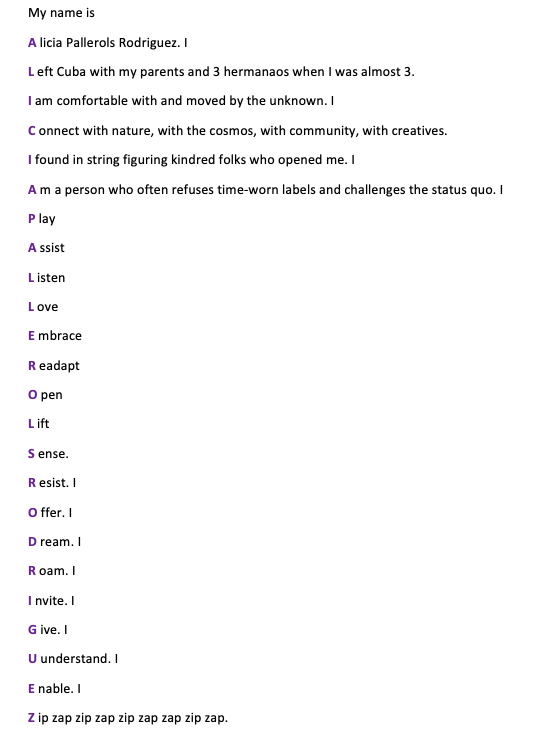
“Dreaming is my other reality… Embracing happens effortlessly..” (Alicia, String Figurer)
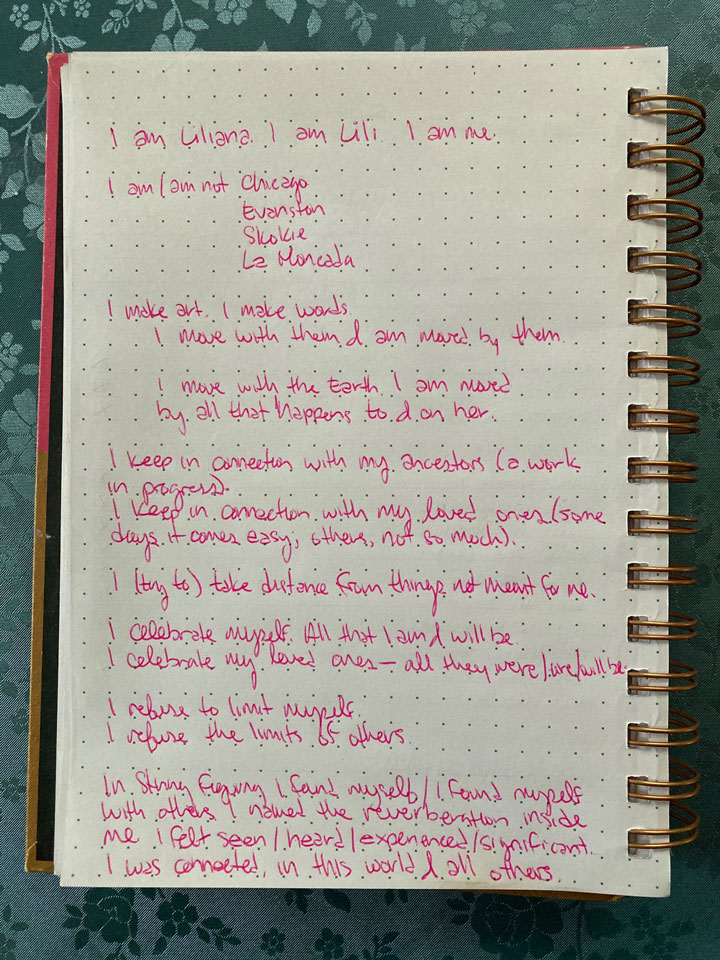
“I refuse to limit myself… I refuse the limits of others” (Lili, String Figurer)
“...Our task is to learn how to hear what is impossible.” (Sara Ahmed, 2004, p. 35)

"the background is a new leaf of my red banana plant named raulito after my abuelo raul diaz on the same side who also has passed on. i dug raulito out the backyard of my mother's house this august with my hands to bring them with me." (Tacia, String Figurer)
ulises fonseca talavera
lleana fonseca paez
raul diaz
Lucio Cabal
Ligia Escandón
Jose Rodriguez Figueroa
lleana fonseca paez
raul diaz
Lucio Cabal
Ligia Escandón
Jose Rodriguez Figueroa
oda a la naranja
Neruda
anaranjada sea
la luz
de cada
día, y el corazón del hombre,
sus racimos,
ácido y dulce sea;
manantial de frescura que tenga y preserve
la misteriosa
sencillez
de la tierra
y la pura unidad
de una naranja.
Neruda
anaranjada sea
la luz
de cada
día, y el corazón del hombre,
sus racimos,
ácido y dulce sea;
manantial de frescura que tenga y preserve
la misteriosa
sencillez
de la tierra
y la pura unidad
de una naranja.
“Mi abuelo era un mambi in the Cuban war of independence in the 1890s. During the war he was a mambi soldier journalist documenting the war from the battlefields. Later he became a poor protestant evangelist and spread the gospel around Jamaica and Cuba…He was raised Catholic but became a Protestant to resist Spanish colonialism of Cuba.” (Alicia, String Figurer)
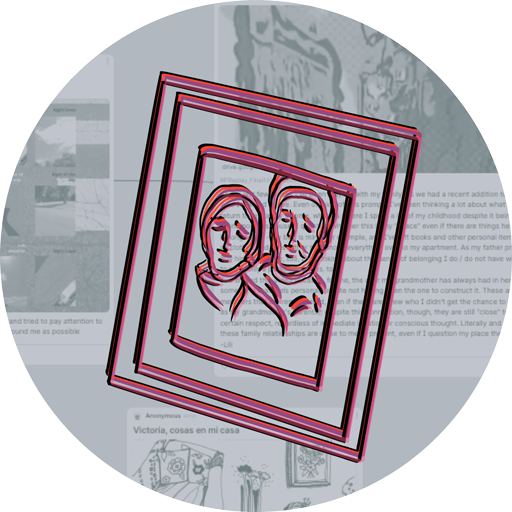
they are still "close" to me in a certain respect, regardless of immediate location or conscious thought.
Literally and figuratively, these family relationships are close to me at present, even if I question my place there sometimes. (Lili, String Figurer)
I have lately been reaching back into that place of me by using my full name up to my abuelas’ maiden names more often than not. (Tacia, String Figurer)

“she has this point about resisting in place that i feel very much inside of as of late--
what does it mean to resist the pressures & structures of violence from where you are? how to escape without literally leaving? how to live your future now, how to not wait to be saved?” (Tacia, String Figurer)
what does it mean to resist the pressures & structures of violence from where you are? how to escape without literally leaving? how to live your future now, how to not wait to be saved?” (Tacia, String Figurer)
“i am missing the ocean
and the canals and the lakes,
but am grateful for this river too.
and the canals and the lakes,
but am grateful for this river too.
this new sky is a lot
like the ones back home
-- big and blue, and
for that i am also grateful.” (Tacia, String Figurer)
like the ones back home
-- big and blue, and
for that i am also grateful.” (Tacia, String Figurer)
So, while we lack the ocean, the sky ocean is wonderful out here in the middle of the cornfields!” (Alicia, String Figurer)
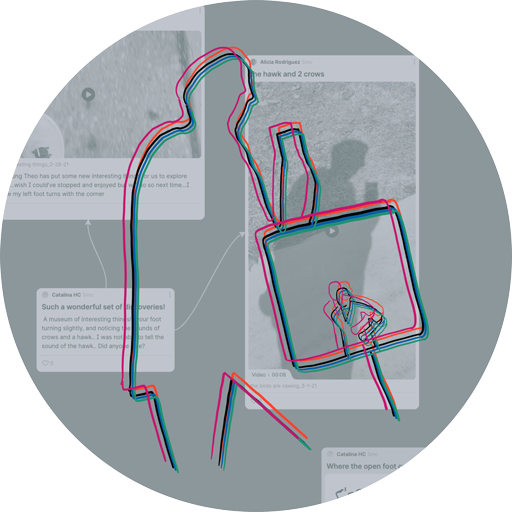
I marvel at the cacophony of sounds, movement, and activity I have walked some of those streets of Barcelona. I had woken up thinking of Spain, my second country.
My first country was Cuba,
Then Spain,
Then the US,
Then Spain,
Then the US,
Then back to Spain, again and again.
It makes me think of what is home, what is close to me, where I have lived, and perhaps why I often feel that the outdoors—what is outside the place where I normally sleep, eat, rest, commune with my family—feels more like home than anywhere else” (Alicia, String Figurer)

“I've been thinking a lot about something Tacia mentioned about tension and how we hold it in our bodies.
We learn our gestures and coping mechanisms from family as often as from other sources.
How much of what we are is reactionary? What does that mean for us?”
(Lili, String Figurer)
“Balancing in a push and pull, connected, orbiting –strings as link, and a form of tension that can still have slack.
You are what we’ve made of you and all the things in between: something liminal but real and solid.”
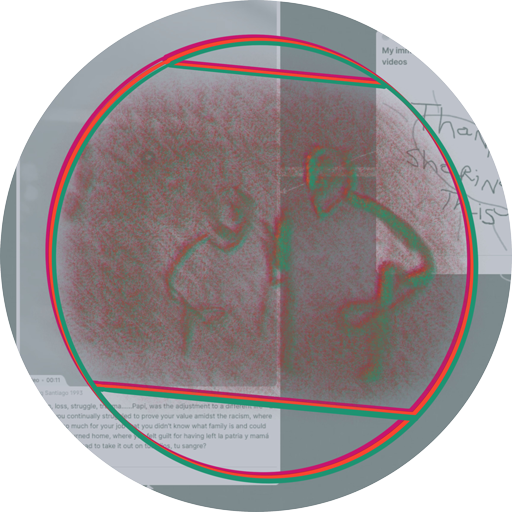
“coming home….a joyful dance con la familia de allá…
Papi, was the adjustment to a different life—amidst the racism, where you traveled so much for your job that you didn’t know what family is and could be when you returned home…” (Alicia, String Figurer)
“My father taught me not to behave or see myself as a minority.
“Don’t be a minority”,
he would say… I tend not to go through the world from my identity as Latina, until that is thrown at me…” (Alicia, String Figurer)

What is the difference between hugging and holding or containing?
“… playing with resistance and tension …has made me think about the support systems that we have within”
(Tacia, String Figurer)
“the touchstones in my everyday are the plants… They look like they don't move, but they do. they don't look like they can talk to one another, but they do…
so i've been taking my lessons from them and learning to figure out what it means to listen to those who've passed on and how the past is in our present” (Tacia, String Figurer)
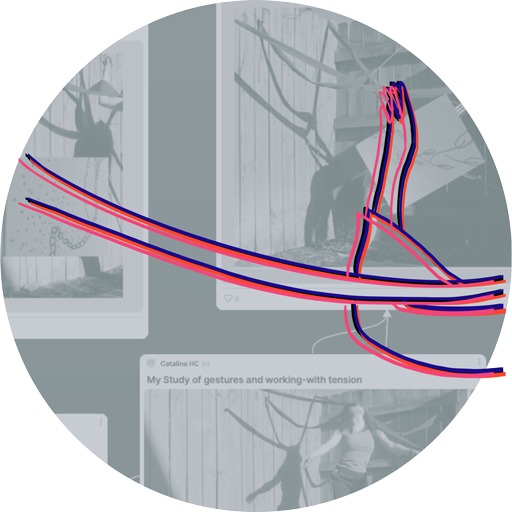
“Beyond tension, we were also in pain”
“Alicia was in pain.
And Tacia was in pain with their back, isolation and circumstances of depression and struggle in their closest family and friends.
Lili and Victoria were in pain with their own struggles with being in isolation and in new places.
I was in pain with a tired body working non-stop in the pandemic and pain from circumstances of acute violence in the country I consider home.”
“The scars on your skin both attach you to a past of loss and a future of survival. This is not a healing. But you have moved on.”
(Sara Ahmed, 2004, p. 38)
 How do you walk/move through the world?
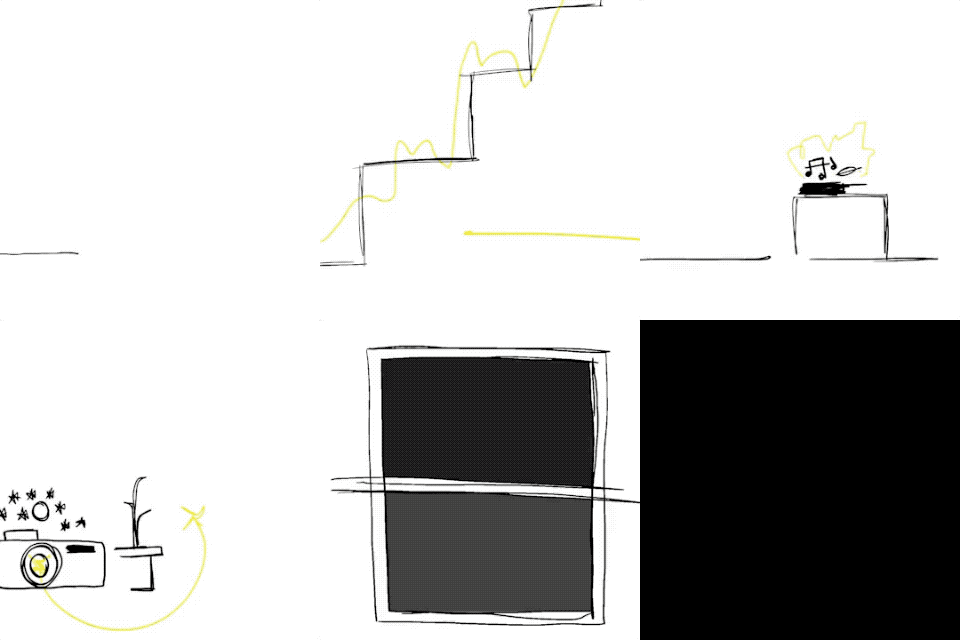 Which gestures and movements keep us connected to loved ones?
 Where are you? What/who is close to you?
 Kaleidoscopic Entangler
 Tension Creature